
12 | 'You Got This'
Lost, disoriented, and ready to quit the Camino after leaving Pamplona, I had to find my way back to the Way.

This post is part of a series following my 500-mile walk on the
Camino de Santiago. Start on Day 1 here.
Day 6: Pamplona to Uterga (13 miles)
“You got this.”
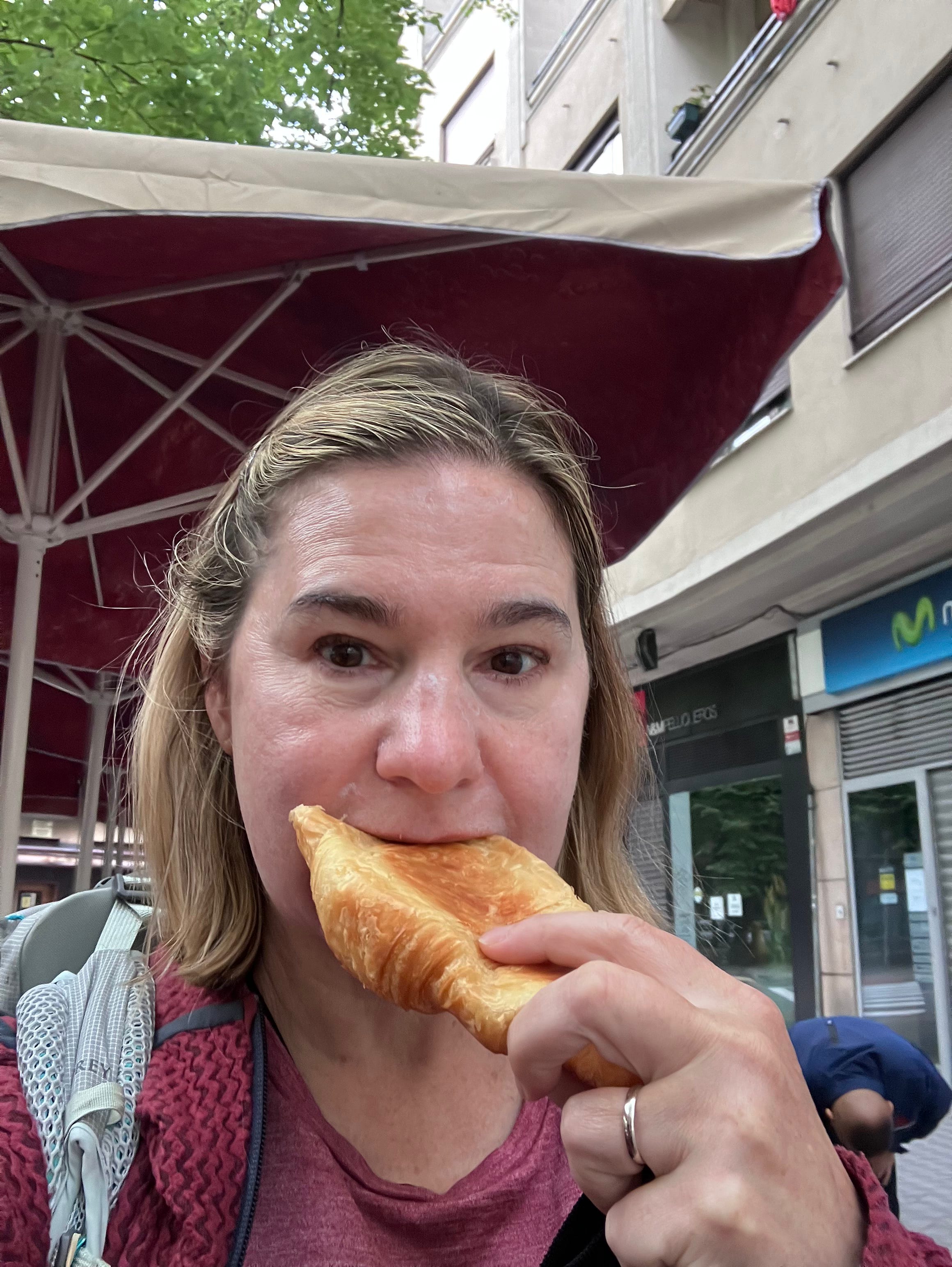
I hate pop-culture clichés. But here I am on a deserted street in Pamplona, stuffing a croissant into my mouth and uttering that line like a character in a fast-food commercial.
My “Camino family” has vanished and I don’t know how to find my way back to the trail. What the hell am I doing here? There is no point to doing this.
I search for shell markers, yellow arrows, errant pilgrims … anything to lead me out of town, so that I can find my way back to the Way.
No signs whatsoever. The streets of Pamplona are quiet. All the other pilgrims seem to have left town. And it’s only 8 am.
Five days ago, I began this Camino with the excitement of a teenager who’d just been set loose in Europe. Today, I’m a lonely and exhausted 57-year-old who foolishly thought that walking 500 miles by myself would be easy and fun.
Forty miles in, it is neither. I’m tempted to call it a Camino and go home.
But with a sinking feeling, I realize that even if I stop walking now, I won’t go home the same. Because there’s an ache inside of me and it isn’t going away.
If I stop walking, it just sits there and hurts. If I walk, at least I’m moving. And that’s better than just sitting with that pang.
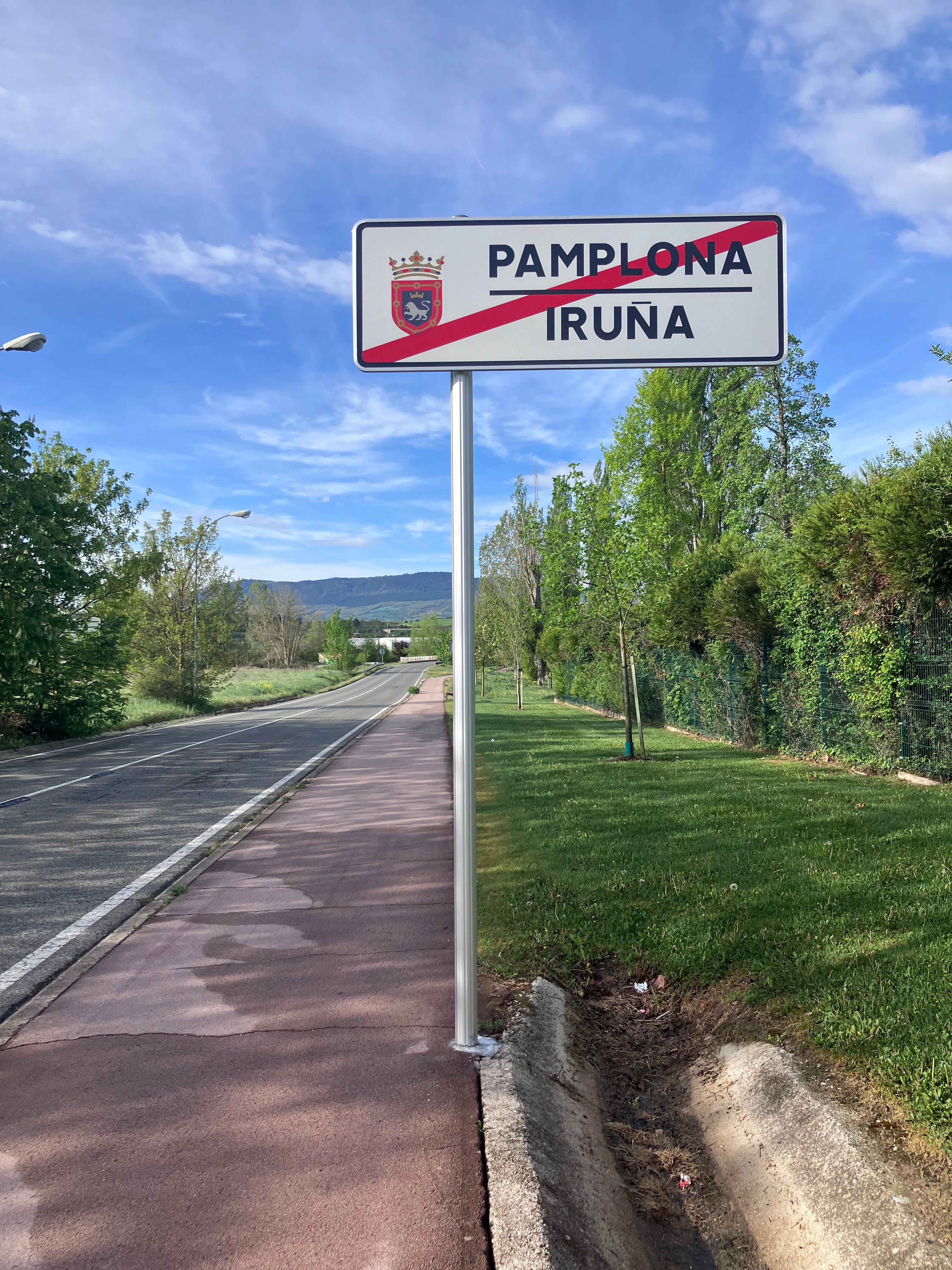
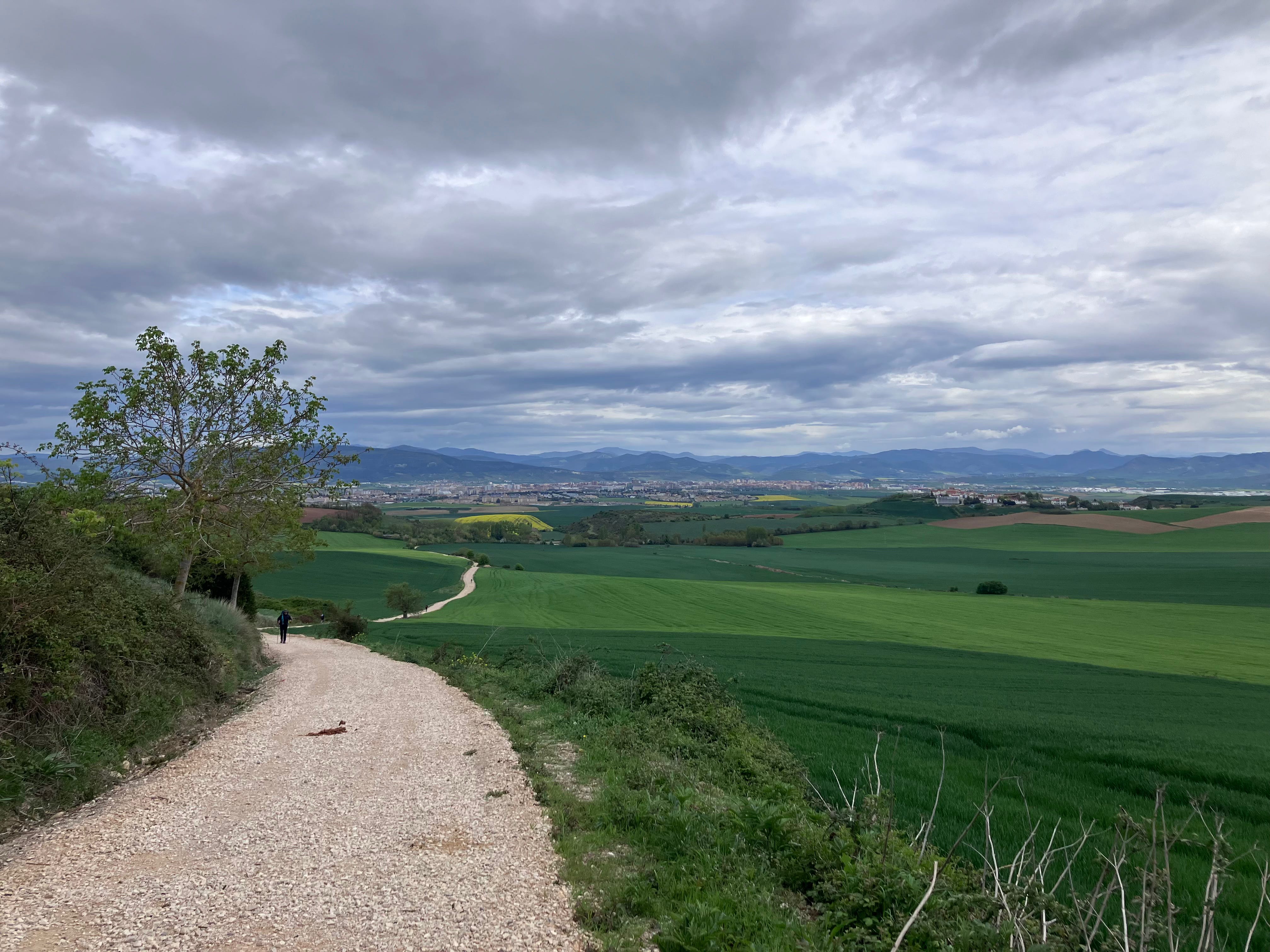
Finally, I spot a tiny Camino sign near the edge of town and find the trail: a long, ordinary road that could lead anywhere. I set forth, my hiking poles clicking like a metronome, and head west.
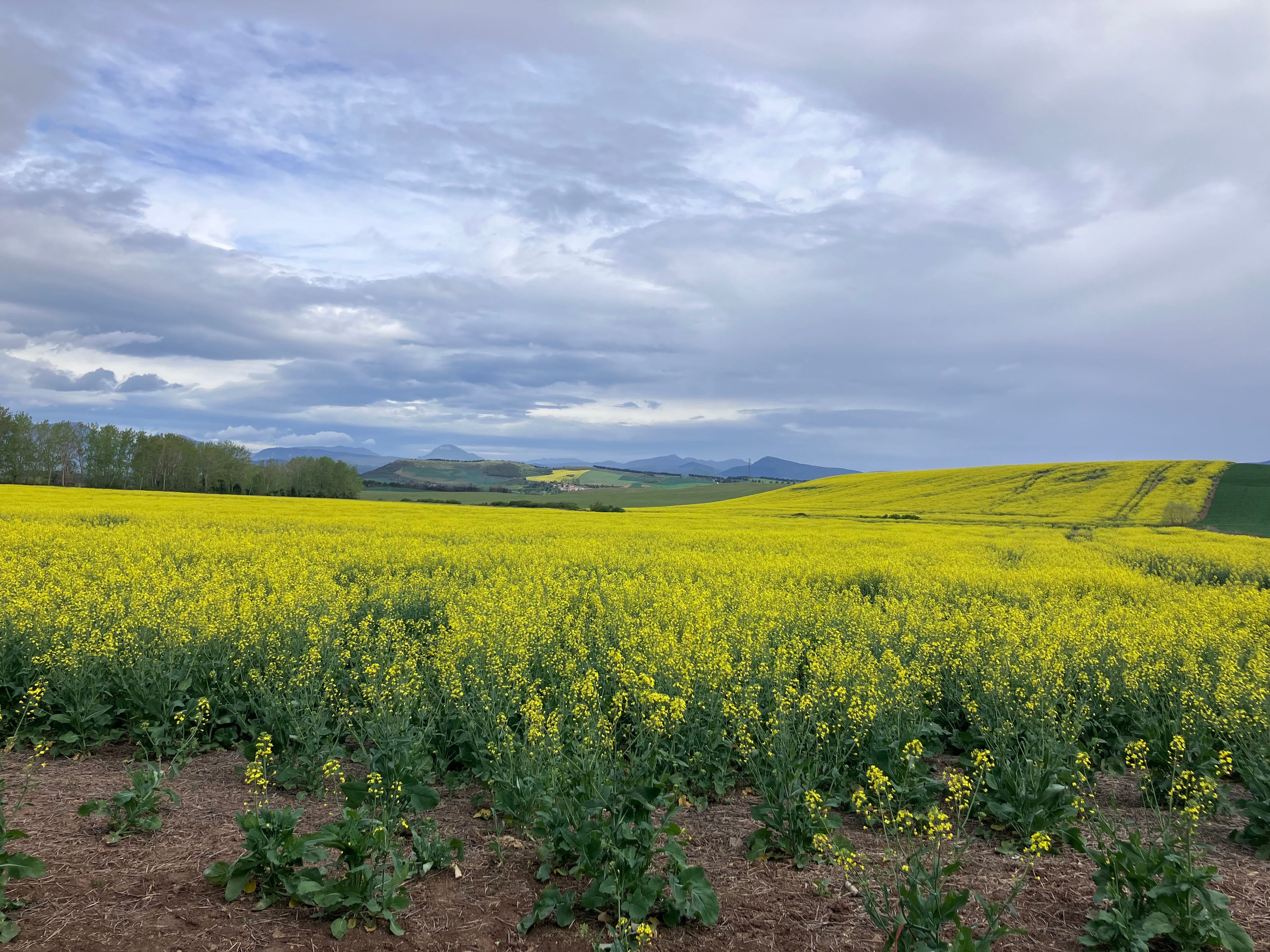
The rhythm is soothing and the path slopes up into the hills, through vast fields of yellow wildflowers that pierce through my solitude and momentarily take my breath away.
But the damn ache returns.
I spot a female pilgrim ahead of me. She tells me she’s from Ireland and that she’s also walking alone. We chat for a few minutes, but then she drifts away. I try to spark a conversation with a father-and-daughter duo from Canada, but they don’t respond with the same interest, so I let them go too.
Then, ahead, I spot Steve, part of the Australian trio I’d shared dinner with the night before! My shoulders sink with relief to see a familiar face, one that I know won’t turn me away.
We fall into step, but the trail heads upward, so it is a bit like trying to have a conversation in the middle of a workout. So after a few words about the weather, the scenery, and the distance yet to travel, we walk quietly, and a bit self-consciously.
But a tentative feeling starts to come over me: he is my friend.
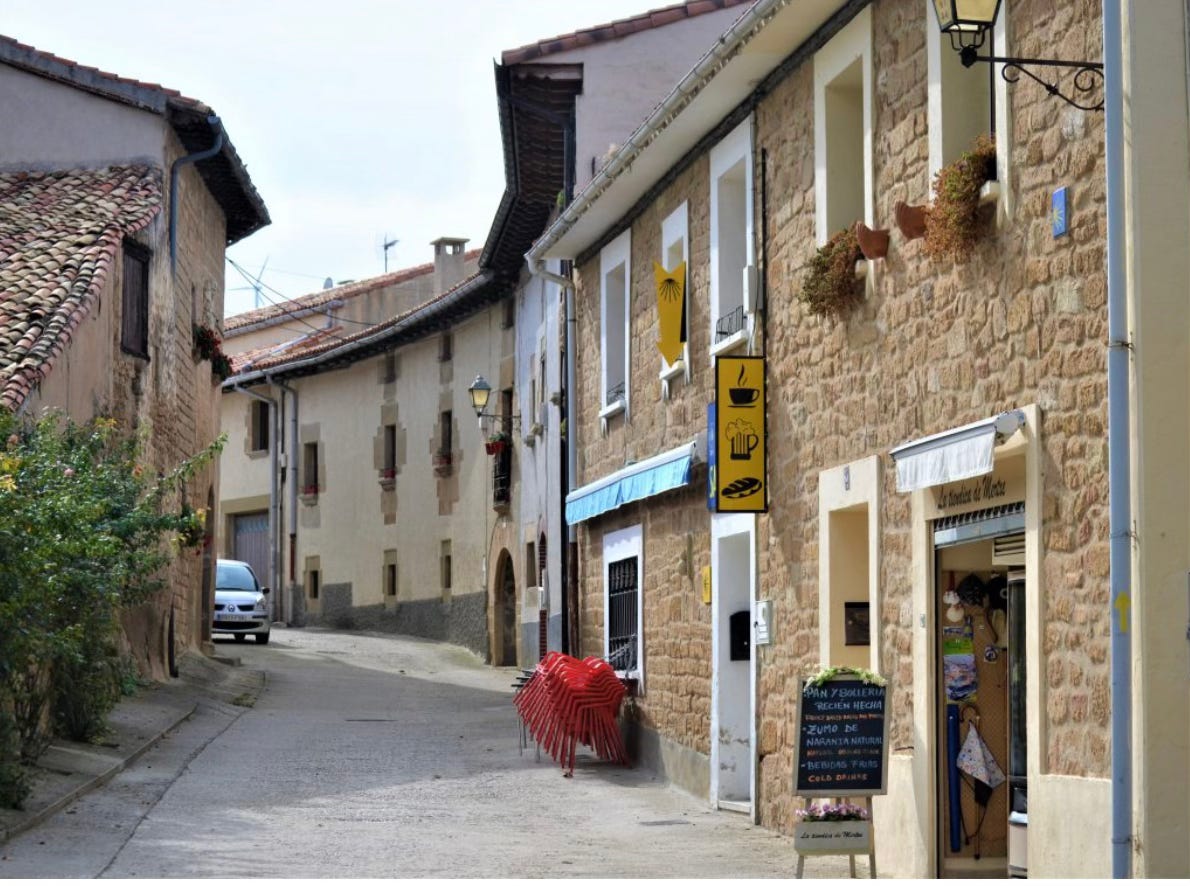
Steve and I arrive in the tiny town Zariquiegui, a single winding street of stone houses. He’s done for the day, so he’ll wait for his companions and spend the night. I can’t find a place to stay in this village, but there’s a hostel with a bed for me in Uterga, a few miles away.
So Steve and I part, which is how it seems to go on the Way … you just say goodbye, knowing there’s a good chance you will never see each other again.
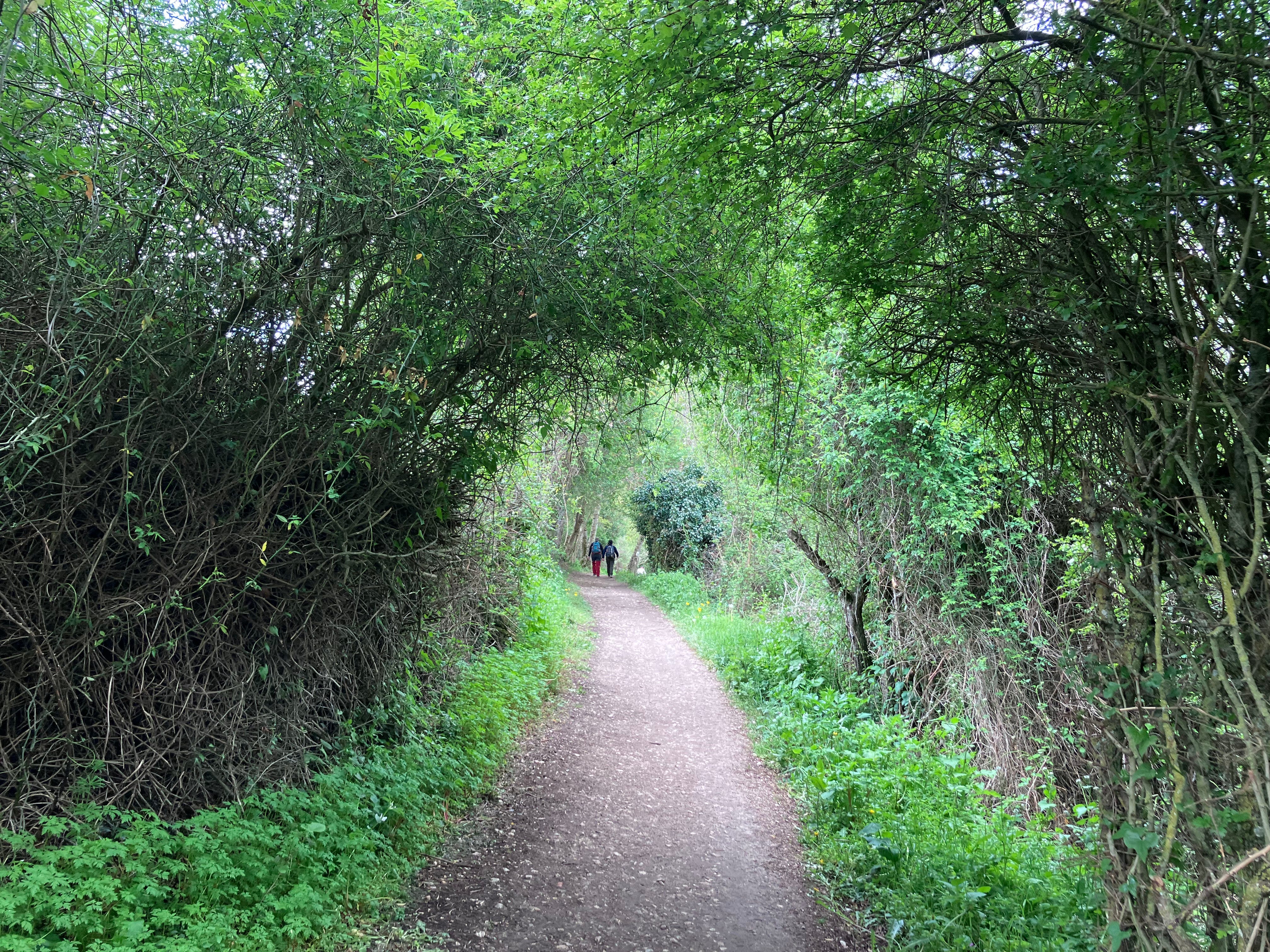
The trail leads steeply upward to ascend the Alto del Perdon, the “Hill of Forgiveness.” I pass under an archway of trees, their branches forming a cloister for reflection or repentance.
But what greets me at the top is not a confessional or a shrine, but the endless sky and the wind. And the massive view — from the Pyrenees receding in the east and Pamplona down below, to the horizon in the west, disappearing into the distance.
I can see the Camino path as it unspools and fades into this infinity, and I pause to let it sink in: as I walk beyond that horizon, I will be rounding the curvature of the Earth.
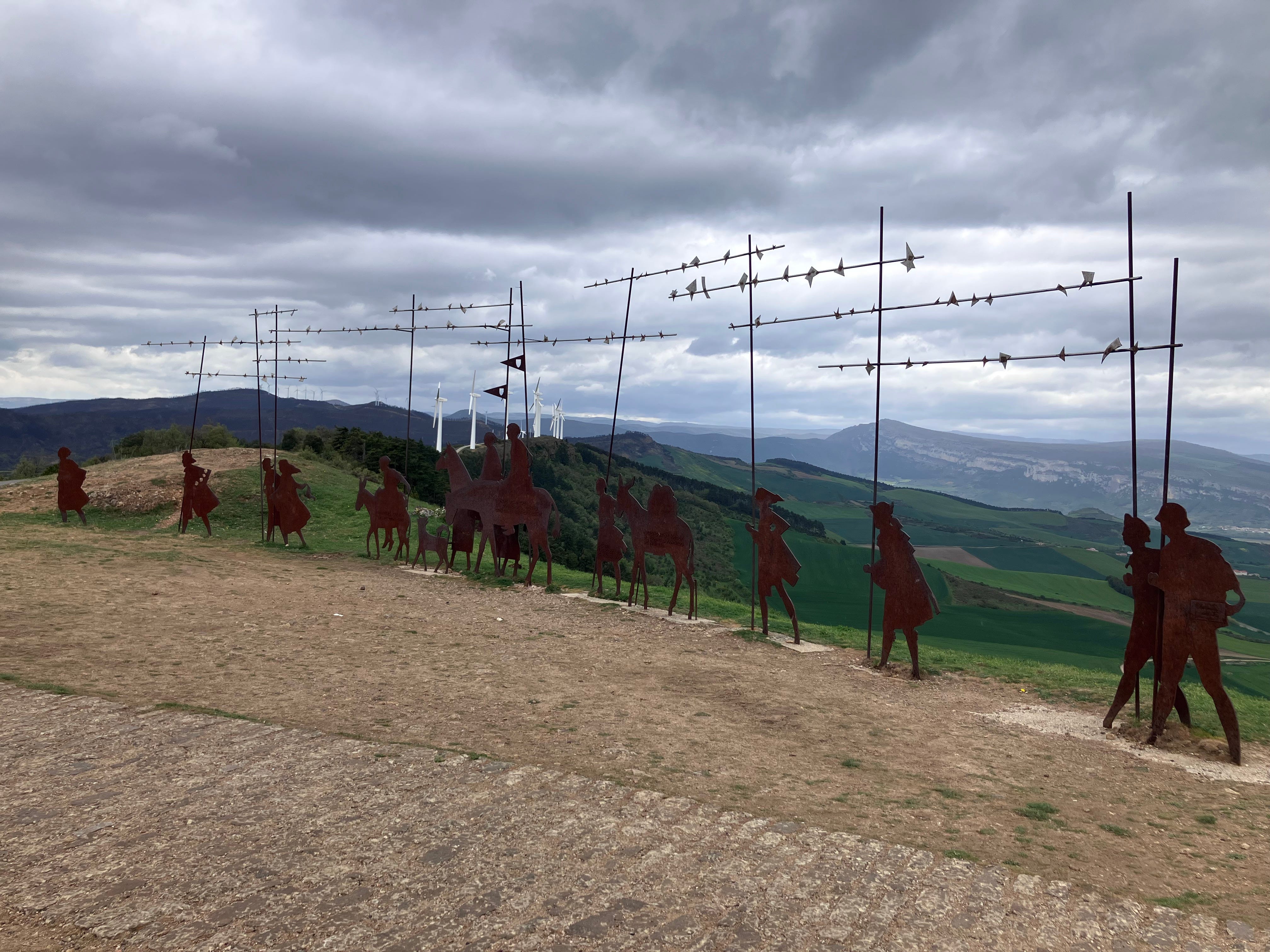
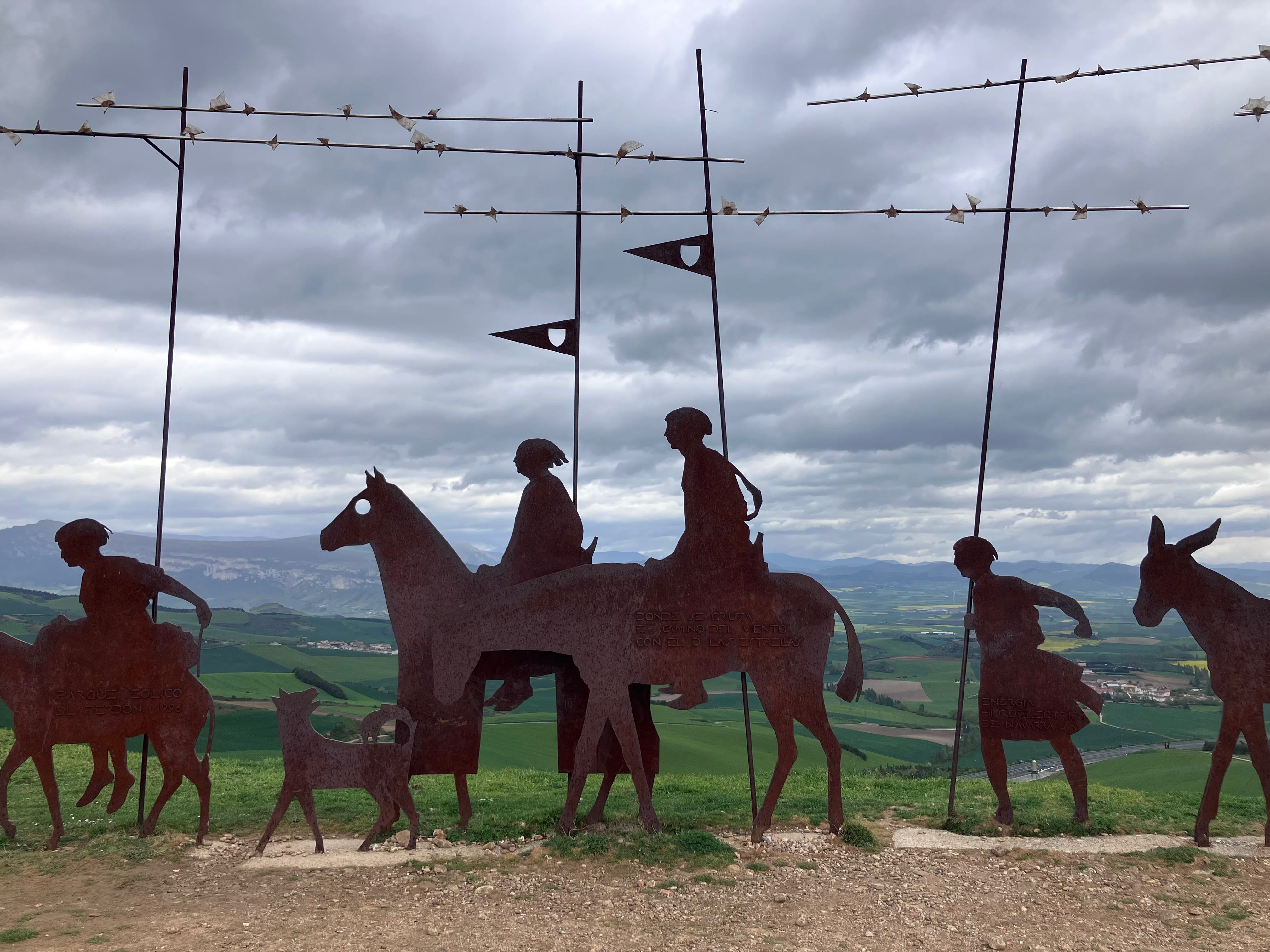
Before me is an image I’ve seen a thousand times: the Monumento al Peregrino, the iconic sculpture of pilgrims through the ages.
I’d seen this sculpture in the Martin Sheen film about the Camino, The Way. I feel starstruck … and then I realize that I am now the one on the stage. I pause to bow to whatever force is spiriting me forward.
I am really doing this, I think. I am walking the Camino de Santiago.
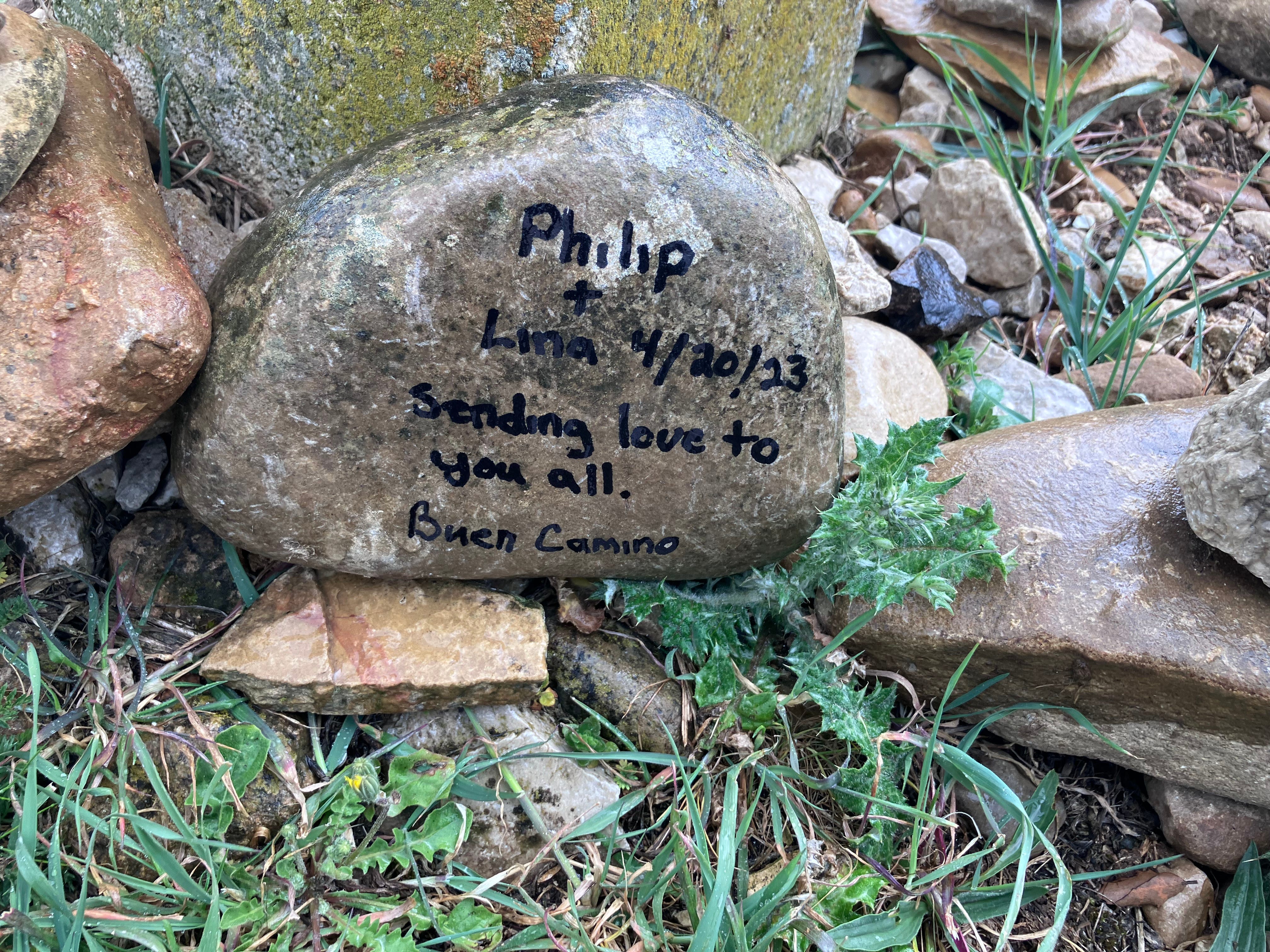
I pick my way down the Alto del Perdon. The loose stones are tiring to my feet, and for some reason, piles of them have been gathered into cairns everywhere.
I notice that some stones have the same message written on them: “Philip + Lina, 4/20/23. Sending love to you all. Buen Camino.”
I feel a small surge of love for Philip and Lina, because that love actually means something to me out here, walking by myself. I pause to let it fill me.
And then I move on.
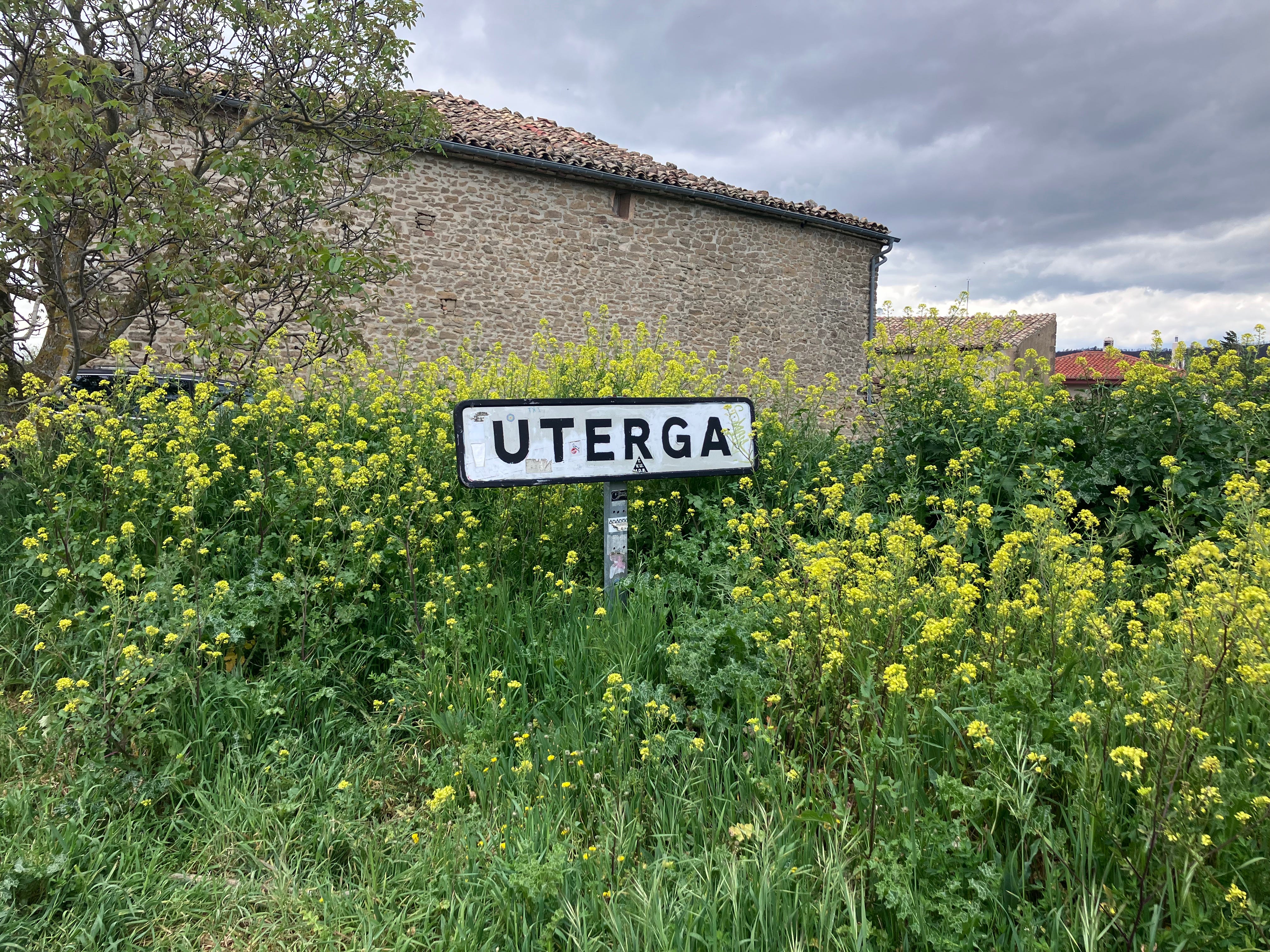
Outbuildings start to appear, then a street, then what looks like another very small and ancient town. I’m in Uterga.
I find my hostel, the Albergue Casa Baztan. The hostel is noisy, has only a couple of toilets and showers, and my lower bunk sags like a hammock. It also offers a communal dinner, which I eagerly pay the 13 Euro to partake in.
At the meal, I find myself dining with a Pole, a French Canadian, a Romanian, a Brazilian, and an Irishman. The discussion is warm and lively, and carries on well into the evening.
The Romanian has done the Camino nine times. I ask him why. He turns the question right back onto me. I say I don’t really know why I am doing this.
“You will know why when you arrive at the Cathedral in Santiago,” he promises.
My bunk will sag all night. I’ll have zero privacy, and people will be snoring all around me.
But right now, I feel like I am precisely where I am supposed to be.
Because I’m no longer lost, and I am no longer alone. And tomorrow, I know exactly where to pick up the trail.
I got this.
As my chest rises and falls, the ache within it subsides for now, and I drift off to sleep.
—April 23, 2023
Continue to Day 13: An American Pilgrim on the Camino
This post is part of a weekly series following my walk on the
Camino de Santiago, a 500-mile pilgrimage route across northern Spain.
Subscribe now and don’t miss a step!
Just joining? Start from Day 1
If you enjoyed this post, please
share a comment, hit “like,” re-Stack,
and share it with your friends.
And, only if you feel like it, you could ….
Do you know what the most beautiful part about your writing is?
It's your humanity. It shows up in every line.
You show your highs and your lows, and everything in between. The loneliness, the lostness that you felt, the hope when you met Steve, and the melancholy that came over when you knew that you would part again.
You felt the full breadth of the human experience in a day.
I see the powerful change unfolding as you take this walk, and there's so much humor in it too.
Seeing you eating a croissant, I just started chuckling. There's nothing more human than that—stuffing your face—and yet you put it out here for all of us to see. Sleeping with snoring bodies all around you with zero privacy. All of it shows the walk for what it is:
To learn how to be human.
Thank you for taking us along this journey, and now you've given me the bug as well!
These powerful words "If I stop walking, it just sits there and hurts. If I walk, at least I’m moving. And that’s better than just sitting with that pang", really resonated with me. A brilliant way to describe the ache of stagnation. Choosing to walk and to travel solo is incredibly brave, powerful and inspirational at any stage of life. It’s a beautiful reminder that moving forward - even when it feels daunting - is always better than staying stuck in place. I look forward to catching up with your travels 🙏